
The BBQuill journal
Smoked Chicken Temperatures: Safe First, Tender Where It Counts
A practical guide to checking smoked breasts, thighs, wings and whole birds, with safety temperatures separated from texture preferences.
The breast is at temperature, the thighs are lagging, and somebody is asking when dinner will be ready. This is where one number for “the chicken” stops being useful.
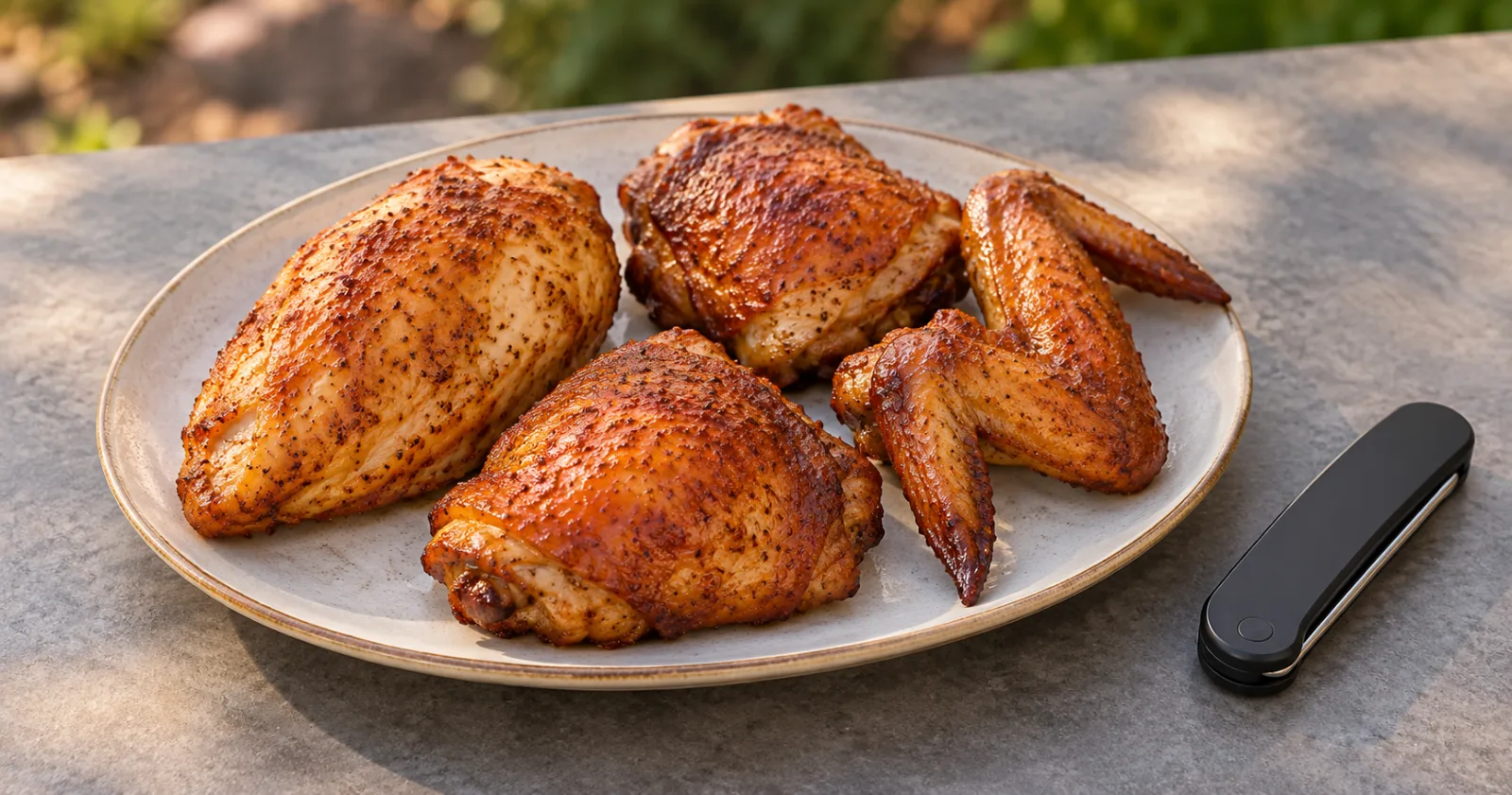
For a straightforward home-smoking method, cook every chicken cut to at least 165°F in the appropriate places before taking it off the heat. That is the USDA consumer recommendation. You may prefer thighs and legs cooked further for texture, but a higher preference does not make a safely cooked piece unsafe below it. FoodSafety.gov lists the same safety minimum for every poultry cut.
A useful temperature chart by cut
Cut | Safety check | Texture decision |
|---|---|---|
Breast | At least 165°F at the coldest valid reading in the thickest part | Start checking early enough to avoid overshooting while other pieces finish. |
Thigh or drumstick | At least 165°F in the thickest meat, clear of bone | Around 175–185°F is a useful range to explore if you prefer softer dark meat. |
Leg quarter | Check both the thigh and drumstick; each must reach 165°F | Judge the pieces separately instead of assuming one reading covers both. |
Wing | At least 165°F in the thickest meat, clear of bone | Continue for the bite and skin you want; a higher number is a preference, not a separate safety rule. |
Whole or spatchcock chicken | At least 165°F in the thickest breast and innermost thigh and wing | The breast and dark meat can finish differently, even on a flattened bird. |
USDA identifies those three checking locations for a whole bird in Chicken from Farm to Table. ThermoWorks discusses why dark meat often benefits from cooking beyond the safety minimum. The suggested thigh range above is a texture starting point, not a requirement to keep every safe chicken cooking.
Find the cold spot instead of the most reassuring number
A probe tip close to the surface can show a higher reading than the center. Bone, a cavity or an awkward angle can also give you a reading that does not represent the meat you meant to check.
Use a clean instant-read thermometer to check a few nearby positions in the thickest part. On a thin breast, inserting from the side can make it easier to put the sensing area in the center. Follow the thermometer's instructions for insertion depth, and keep the tip clear of bone.
If a sensible placement reads below 165°F, keep cooking. If a reading seems implausible, check the placement and confirm it; don't simply throw out the lower number because another spot looked better. ThermoWorks' chicken temperature guide explains the importance of locating the thermal center.
A leave-in probe is useful for following the cook. It still reports only where that probe sits. A whole bird needs the other locations checked before it is ready to serve, and a tray of pieces needs more than one representative reading.
Give breast and dark meat room to finish differently
When cooking separate pieces, take each piece off once it has reached its safety target and the texture you want. There is no prize for keeping an already-finished breast on the smoker until every thigh reaches your preferred higher temperature.
With a whole bird, check the breast, thigh and wing rather than choosing a compromise reading. Spatchcocking changes the shape and can help the bird cook more evenly, but it does not guarantee identical temperatures or remove the need for those checks.
If mixed cuts repeatedly give you dry breast and underdone dark meat, make the next cook easier to manage: use separate pieces, leave space to move them, and note which part of the cooker runs hotter. Change one part of the setup at a time so you can tell what helped.
Don't build the safety plan around carryover
Food can continue heating internally after it leaves the cooker. How much it rises depends on the cut, its size, the cooking temperature and how it rests. A small piece may have very little rise.
That is why this guide does not tell you to pull a breast at 157°F or 160°F and assume a rest will finish the job. Lower-temperature poultry methods require a properly controlled time-and-temperature process; a guessed carryover rise is not that process. For this method, verify 165°F before pulling, then use your notes to avoid unnecessary extra cooking next time.
The goal is juicy chicken with a measured endpoint. Check often enough near the finish that you can take it off promptly, rather than lowering the safety target to compensate for checking late.
Treat crisp skin as a separate job
A safe internal temperature does not promise crisp skin. A long, gentle smoke may leave the skin softer than you wanted. Follow a chicken recipe suited to your cooker, and if it calls for a hotter finishing step, stay within the appliance's operating limits and watch closely.
Keep the internal checks in the plan during that finish. Browning, a smoke-pink interior or clear juices cannot replace the thermometer. Sugary sauce can darken before the center is ready, so appearance is a poor shortcut.
Plan the sides around a short finish
Have the serving dishes and quick sides ready when the chicken approaches its target. If a delay turns into a hold, keep cooked chicken at 140°F or above and check it. Otherwise refrigerate within two hours, or one hour above 90°F, following USDA leftover guidance.
For a meal spread across a smoker and a grill, our back-scheduling guide helps reserve space for the sides without pretending every item finishes at the same moment.
Record the cut, measured grate temperature, final readings and what you thought of the bite. BBQuill keeps probe readings and notes with the cook, so “breast was good; try the thighs a little further next time” stays attached to the temperatures that produced it.